Cyber due diligence in M&A: what you need to know

When a deal goes wrong because of a hidden data breach, no amount of financial modelling saves you. Understanding what is cyber due diligence in M&A has shifted from a technical nicety to a commercial necessity, and organisations now prioritise cybersecurity during due diligence 2.3 times more than in 2023. Yet most deal teams still treat it as a checkbox exercise handled by IT. That misunderstanding costs acquirers hundreds of millions. This guide gives you the full picture: scope, process, regulatory context, and how cyber findings should directly shape your deal terms.
Table of Contents
- Key takeaways
- What cyber due diligence in M&A actually means
- Critical documents and assessments to request
- Common pitfalls that derail deals
- Translating cyber findings into deal terms
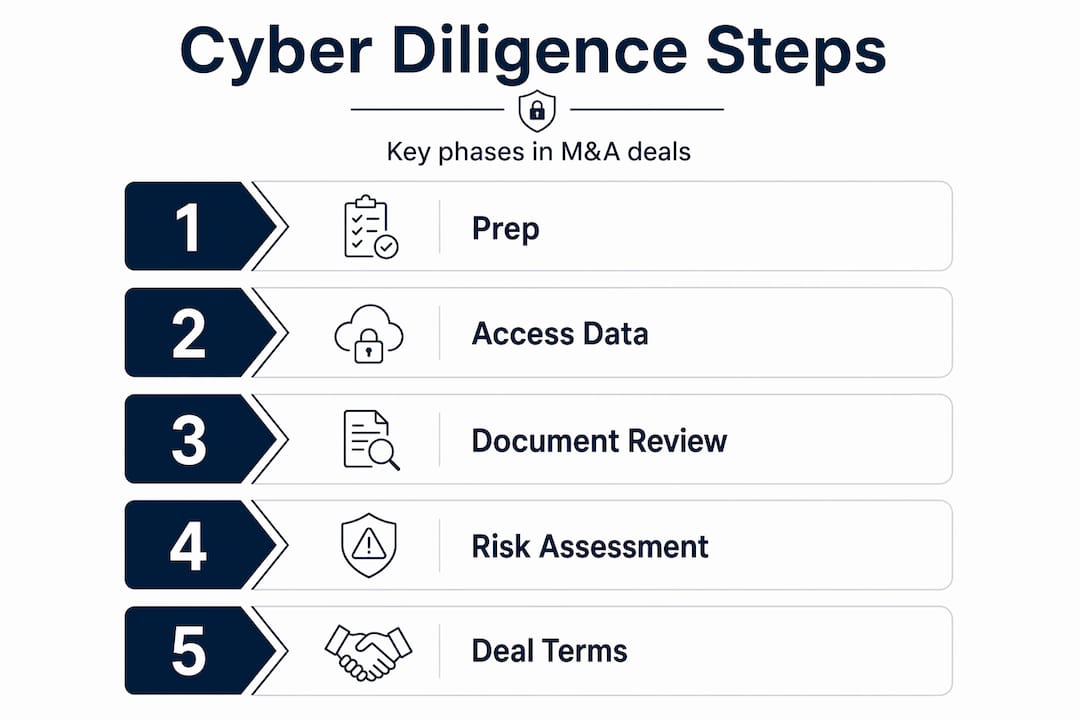
- How to conduct cyber due diligence step by step
- My perspective: why most deal teams are still getting this wrong
- How Musketeers-security supports M&A cyber due diligence
- FAQ
Key takeaways
| Point | Details |
|---|---|
| Cyber risk is a deal issue | Hidden breaches and governance gaps can reduce purchase prices or create costly post-close liabilities. |
| Run it in parallel | Cyber due diligence must run alongside financial and legal workstreams, not after them. |
| Quantify, do not just describe | Cyber Risk Quantification converts technical findings into financial loss estimates that influence deal pricing. |
| Regulations are tightening | GDPR, NIS2, and the EU AI Act create material compliance exposure that buyers must assess before signing. |
| Start in 72 hours | Sophisticated buyers begin initial screening within 72 hours of data room access to identify high-impact risks early. |
What cyber due diligence in M&A actually means
Cyber due diligence is the structured assessment of a target company’s cybersecurity posture, breach history, regulatory exposure, and technical controls, carried out as part of a broader M&A process. It is not a penetration test. It is not an IT audit. It is a risk discipline that sits at the intersection of technical, legal, commercial, and financial analysis.
The scope covers several distinct areas:
- Breach history and incident logs: Has the target suffered a reportable breach? Were regulators notified? Were customers informed? Were remediation steps documented and completed?
- Technical controls and architecture: Are systems patched, segmented, and monitored? Do access controls reflect least-privilege principles?
- Regulatory compliance: Does the target meet GDPR, NIS2, and sector-specific obligations? Are certifications current and in scope?
- Third-party and supply chain exposure: What vendors have access to sensitive data or critical systems? Have those relationships been assessed?
- Cyber insurance coverage: Does existing coverage align with the actual risk profile, and will it transfer or need renegotiation post-close?
Cyber risk spans commercial, legal, and financial domains and must be assessed holistically, not in isolation. A vulnerability in a customer-facing application is not just a technical problem. It is a potential source of customer churn, regulatory fines, and remediation cost, all of which affect enterprise value.
Pro Tip: Request access to the target’s virtual data room for cyber-specific documents at the same time as financial and legal teams receive access. Any delay creates blind spots that compress your review window.
Critical documents and assessments to request
The quality of your cyber due diligence is only as good as the evidence you review. Generic questionnaires rarely surface material risk. You need specific document classes, and you need them early.
- Penetration test reports from the past 24 months, including scope, findings, and evidence of remediation. A test without a remediation record is nearly worthless.
- Incident response logs and breach notifications, including any regulatory correspondence. Look for patterns, not just isolated events.
- Cyber insurance policies, including coverage limits, exclusions, and any claims history. Financial sector breaches average $5.56 million in costs, well above the global average, so coverage gaps matter enormously.
- Security certifications such as ISO 27001 and SOC 2 Type II. Certification recency and scope are critical indicators. A certificate issued three years ago and covering only one office tells a very different story than a current, group-wide certification.
- AI governance documentation for any targets deploying machine learning or automated decision systems. EU AI Act enforcement from August 2026 introduces fines of up to €35 million or 7% of global turnover for non-compliance, making this a material deal risk.
- Network architecture diagrams and access control policies, which reveal whether security is built into the environment or bolted on.
- Third-party vendor contracts and security assessments, particularly for cloud providers and data processors.
Each of these documents feeds into multiple workstreams simultaneously. Incident logs inform legal liability analysis. Insurance policies affect financial modelling. Architecture reviews shape integration planning. This is precisely why cyber diligence cannot be siloed within a technical team.
Common pitfalls that derail deals
The most expensive mistakes in M&A cyber diligence are rarely technical. They are structural and organisational.

The first and most damaging error is running cyber diligence sequentially rather than in parallel. Cyber due diligence must run alongside financial and legal workstreams to avoid post-close surprises. When cyber findings arrive after the purchase agreement is drafted, your leverage to adjust terms, escrow, or indemnities is already gone.
The second pitfall is underestimating the cross-disciplinary impact of cyber risk. Deal teams often assume that a technical finding is a technical problem. It is not. A poorly segmented network that exposes customer data is a GDPR enforcement risk, a reputational liability, and a remediation cost, all at once. Mapping cyber risk across commercial, legal, and financial workstreams is not optional; it is the only way to price the risk accurately.
- Undisclosed breaches are a particular danger. The Verizon-Yahoo and Marriott-Starwood cases both demonstrate how undisclosed breaches reduce purchase prices by hundreds of millions or generate post-close regulatory and litigation costs that dwarf the original deal economics.
- Post-close integration periods are the highest-risk window for cyber attacks. Threat actors probe newly merged environments precisely because access controls are in flux and monitoring coverage has gaps.
- Generic indemnification caps without quantified cyber risk exposure leave buyers exposed. A standard 10% escrow holdback is meaningless if the actual cyber liability is three times that figure.
Pro Tip: Ask the target directly whether any regulatory authority has made enquiries about data handling or security practices in the past three years. The answer, and the hesitation before it, tells you a great deal.
Translating cyber findings into deal terms
This is where cybersecurity due diligence moves from analysis to commercial impact. Findings that cannot be expressed in financial terms rarely influence deal terms. Findings that carry a price tag always do.
Cyber Risk Quantification is the mechanism that makes this possible. CRQ translates cyber exposures into expected financial loss estimates, expressed as probability-weighted ranges rather than vague severity ratings. That output integrates directly into enterprise value calculations, remediation cost adjustments, and indemnity negotiations.
| Cyber finding | Deal mechanism |
|---|---|
| Unpatched critical vulnerabilities | Remediation cost deducted from enterprise value |
| Undisclosed breach under investigation | Escrow holdback pending regulatory outcome |
| Expired or insufficient cyber insurance | Buyer requires coverage upgrade as condition precedent |
| Non-compliant AI systems under EU AI Act | Indemnity clause covering regulatory fines and recall costs |
| Weak access controls and no MFA | Operational cost uplift factored into post-close budget |
“The moment you can say ‘this finding represents a £2.4 million expected loss over three years,’ the conversation in the boardroom changes entirely. It stops being a technical concern and starts being a deal variable.”
Timing matters enormously here. Cyber findings must be delivered before the purchase agreement is signed. Post-signing discoveries severely limit your options and almost always favour the seller. Build your M&A cyber risk assessment timeline so that a consolidated findings report lands at least two weeks before the anticipated signing date.
How to conduct cyber due diligence step by step
Knowing what to look for is half the battle. Knowing how to organise the process is the other half. Here is a practical sequence that works for both strategic acquirers and financial investors.
- Initiate at data room opening. The moment the virtual data room is accessible, your cyber team should begin document triage. A 72-hour initial screening window allows you to identify maturity indicators quickly and flag whether a deeper technical assessment is warranted.
- Assemble a multidisciplinary team. You need a technical cyber specialist, a legal adviser with data protection expertise, and a cyber insurance consultant. These three roles cover the full risk surface. Using only technical staff produces findings that legal and finance teams cannot act on.
- Request the critical document set. Use the list from the previous section as your baseline cyber due diligence checklist for M&A. Supplement it with sector-specific requirements, for example, PCI DSS evidence for payment processors or NHS data security standards for healthcare targets.
- Commission external technical assessments where access is granted. Architecture reviews and external attack surface scans can be conducted without full system access and provide independent validation of what the documents claim.
- Use AI-assisted analysis tools to process large document sets efficiently and create traceable audit trails. Several specialist platforms now exist for M&A cyber risk assessment that flag regulatory gaps and cross-reference findings automatically.
- Produce a consolidated findings report that maps each cyber risk to its commercial, legal, and financial impact. This document should be written for a CFO and a general counsel, not just a CISO.
- Embed remediation planning into integration planning. Cyber findings do not end at signing. The post-close integration roadmap must include specific remediation milestones, ownership, and budget. Post-announcement periods carry the highest cyber attack risk, so continuity of monitoring is non-negotiable.
You can also access free cyber readiness resources to benchmark your current diligence approach before engaging a specialist.
My perspective: why most deal teams are still getting this wrong
I have watched deals close with cyber risks that were visible in the data room, simply because no one was looking in the right place at the right time. The problem is rarely a lack of information. It is a lack of integration.
Traditional sequential diligence, where cyber comes after financial and legal sign-off, is no longer viable. By the time cyber findings land, the commercial team has already anchored on a price, and nobody wants to reopen negotiations. The result is that material risks get rationalised rather than priced.
What I find genuinely encouraging is the shift toward quantification. When you can tell a deal committee that a target’s unpatched infrastructure represents a £1.8 million expected annual loss, with a 30% probability of a breach in the first 18 months post-close, that changes behaviour. Abstract concerns about “cyber hygiene” do not move deal terms. Financial loss estimates do.
The regulatory environment is accelerating this shift. NIS2, GDPR enforcement, and the incoming EU AI Act obligations mean that cyber governance and compliance is no longer a soft consideration. It is a hard liability. Investors who treat it as such will consistently outperform those who do not.
The future of M&A cyber due diligence belongs to teams that treat it as a financial discipline with a technical input, not a technical exercise with a financial footnote.
— jalil
How Musketeers-security supports M&A cyber due diligence
Cyber risk in a deal moves fast, and generic assessments rarely capture what actually matters. Musketeers-security works directly with acquirers, investors, and legal advisers to deliver focused, evidence-based cyber due diligence that integrates with your existing deal workstreams.

From initial data room screening through to post-close integration monitoring, the team brings certified expertise across technical assessment, regulatory compliance, and cyber incident response and insurance. Musketeers-security’s partnership with Lloyd’s of London means that cyber insurance implications are assessed alongside technical findings, not as an afterthought. Whether you need a rapid 72-hour screening or a full M&A cyber risk assessment, the team delivers findings in a format your deal committee can act on. Contact Musketeers-security to discuss a tailored assessment for your next transaction via managed security services or direct consultancy engagement.
FAQ
What is cyber due diligence in M&A?
Cyber due diligence in M&A is the structured assessment of a target company’s cybersecurity posture, breach history, regulatory compliance, and technical controls, carried out to identify risks that could affect deal value, legal liability, or post-close operations.
When should cyber due diligence begin in a deal?
Cyber due diligence should begin the moment the virtual data room opens. Sophisticated buyers use a 72-hour initial screening window to identify high-impact maturity indicators before committing to a full technical assessment.
How do cyber findings affect deal pricing?
Cyber Risk Quantification converts technical findings into expected financial loss estimates, which can be used to adjust enterprise value, negotiate escrow holdbacks, or structure indemnity clauses covering regulatory fines and remediation costs.
What documents should a cyber due diligence checklist include?
A cyber due diligence checklist for M&A should include penetration test reports, incident response logs, cyber insurance policies, security certifications such as ISO 27001 and SOC 2 Type II, network architecture diagrams, and AI governance documentation where relevant.
What are the biggest risks of skipping cyber due diligence?
Undisclosed breaches and governance gaps can reduce purchase prices by hundreds of millions, as seen in the Verizon-Yahoo and Marriott-Starwood cases. Post-close integration periods also carry elevated cyber attack risk, making pre-close assessment critical to deal protection.